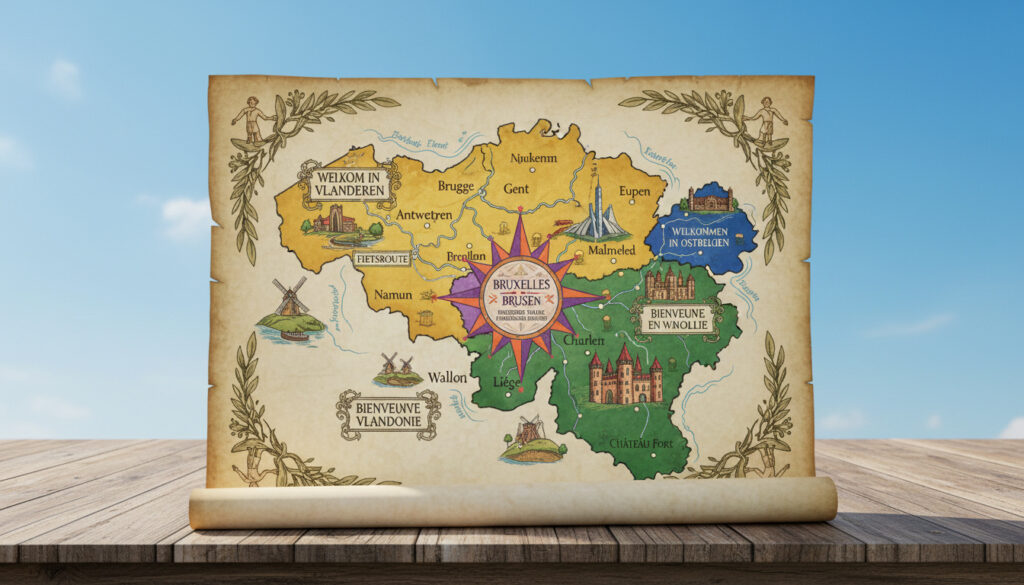
What Language Do They Speak in Belgium – Facts by Region
Belgium operates with three official languages—Dutch, French, and German—yet no single tongue dominates nationwide. The country divides into distinct linguistic regions where specific languages hold legal and practical supremacy, creating a complex multilingual landscape that often surprises visitors.
Roughly 59% of the population belongs to the Flemish Community, where Dutch serves as the primary language. Another 40% fall under the French Community, centered in Wallonia and Brussels, while less than 1% constitute the German-speaking Community in the East Cantons. This distribution stems from Belgium’s position at the crossroads of Germanic and Romance Europe.
Despite these regional boundaries, English proficiency remains remarkably high, particularly in Brussels and Flanders, creating a functional quadrilingual environment for international business and tourism.
What Are the Official Languages of Belgium?
Flanders
~59%
Wallonia & Brussels
~40%
East Cantons
<1%
Nationwide
Widely spoken
- Belgium is officially trilingual but regionally divided, with no single national language.
- Brussels operates as a bilingual island where both Dutch and French hold official status.
- Flemish, spoken in Flanders, is mutually intelligible with Dutch from the Netherlands, though distinct dialects exist.
- English proficiency ranges between 60-90% depending on region and demographic.
- The German-speaking Community represents less than 1% of the population, totaling approximately 79,500 residents.
- Constitutional Article 4 establishes four distinct linguistic regions with strict boundaries.
- Language legislation prohibits using non-regional languages in government-funded education except as foreign subjects.
| Language | Primary Region | % Speakers | Status & Notes |
|---|---|---|---|
| Dutch (Flemish) | Flanders | 59% | Official; includes Brabantian, West/East Flemish, Limburgish dialects |
| French | Wallonia | 36-40% | Official; distinct vocabulary/pronunciation from France French |
| French | Brussels-Capital | ~50% primary | Co-official with Dutch; dominant in daily use |
| Dutch | Brussels-Capital | Minority | Co-official; original Brabantian Dutch now rare due to Francization |
| German | East Cantons | <1% (~79,500) | Official; area ceded from Germany post-WWI |
| English | Nationwide | 60%+ proficiency | Not official; widely used in business/higher education |
| West Flemish | West Flanders/Netherlands border | Regional | Dialect with French loanwords; less intelligible to Netherlands Dutch speakers |
| Limburgish | Limburg province | Regional | Dialect spoken across Belgian-Dutch border |
What Language Is Spoken in Each Region?
Flanders and Dutch
The northern region of Flanders recognizes Dutch as its sole official language. Locally referred to as Flemish, the language encompasses several dialects including Brabantian, West Flemish, East Flemish, and Limburgish. These dialects extend across the border into the Netherlands, though Belgian variants incorporate more French-influenced vocabulary—known as belgicisms—that can challenge comprehension for some Netherlands Dutch speakers.
Despite dialectal variations, core grammar matches standard Netherlands Dutch, enabling mutual intelligibility between speakers from both countries. Public authorities in Flanders operate strictly in Dutch, and government-funded schools teach exclusively in the language.
West Flemish and Limburgish dialects share characteristics with speech patterns across the Dutch border, yet incorporate French and Romance loanwords that create distinct sonic identities. These belgicisms reflect centuries of contact between Flemish and Walloon populations.
Wallonia and French
Southern Wallonia maintains French as its official language. While structurally identical to the French spoken in France, Belgian French carries subtle distinctions in vocabulary, pronunciation, and semantics. The region contains some German-speaking pockets near the eastern border, though French dominates administrative and educational functions.
Brussels-Capital Region
Brussels presents Belgium’s most linguistically complex environment. The capital is officially bilingual, requiring all government services and signage to appear in both Dutch and French. Demographically, however, French dominates: approximately 50% of residents speak it as their primary language, while 45% use it as a lingua franca, according to Introducing Brussels.
Original Brabantian Dutch, once the region’s native tongue, now constitutes a minority language following decades of Francization. In practice, French serves as the most common daily language, though Dutch remains legally equal.
East Cantons and German
Belgium’s smallest linguistic community resides in the East Cantons, where German serves as the official language for roughly 79,500 residents. This territory ceded from Germany following the Versailles Treaty after World War I, experienced brief re-annexation during World War II, then returned to Belgian control. The historical overview notes that German speakers in this region typically command French as well.
Do People Speak English in Belgium?
English Proficiency and Usage
English functions as a de facto fourth language, particularly among professionals, youth, and in Brussels. Most Belgians achieve bilingual status in Dutch and French through education, with many adding English as a third language. Higher education increasingly employs English instruction, despite constitutional prohibitions against using non-regional languages in government-funded primary and secondary schools except as foreign subjects.
Travelers can rely on English in major cities and tourist areas, though attempting basic Dutch phrases in Flanders or French in Wallonia demonstrates respect. Flemish speakers typically know French through mandatory schooling, while German-speaking residents generally command French as well.
Is Flemish Different from Dutch?
Flemish represents a variety of Dutch rather than a separate language. While speakers from Flanders and the Netherlands communicate easily, pronunciation differences, vocabulary variations (particularly belgicisms), and distinct idioms mark the Belgian variant. The Languages of Belgium classification maintains Dutch as the official designation, with Flemish serving as the common regional descriptor. Travel observations confirm that assuming Flemish identity equates to Dutch nationality offends locals, who identify as Belgian.
How Did Belgium’s Language Structure Evolve?
- : Independence establishes French as the dominant administrative language, reflecting the historical influence of Latin culture in the south and Germanic culture in the north.
- : Constitutional revision grants Dutch equal status to French, ending centuries of French administrative dominance.
- : Fixed language borders establish Flanders as Dutch-speaking, Wallonia as French-speaking, and Brussels as bilingual.
- : First state reform begins federalization along linguistic lines, creating the framework for language Communities.
- : German gains constitutional recognition as Belgium’s third official language.
- : Belgium becomes a full federal state with three Regions (Flanders, Wallonia, Brussels-Capital) and three Communities (Flemish, French, German-speaking) based on linguistic areas.
What Is Established and What Remains Misunderstood?
Established Facts
- Three constitutional languages: Dutch, French, and German.
- Strict regional divisions enforced by Article 4 of the Constitution.
- Dutch represents the largest language community at approximately 59%.
- German-speaking Community comprises roughly 79,500 residents in the East Cantons.
Common Misconceptions
- Myth: French is the majority language nationwide. Reality: Dutch holds majority status in population terms.
- Myth: English is an official language. Reality: While widely spoken, English holds no constitutional status in Belgium.
- Myth: Flemish and Dutch are completely distinct languages. Reality: They are mutually intelligible varieties of the same language.
Why Does Belgium’s Linguistic Structure Matter?
Belgium’s language divide reflects deeper historical tensions between Flemish and Walloon populations. The gradual shift from French-dominated administration to federalized language equality emerged through decades of political negotiation. Today, the structure impacts everything from educational funding to government employment, with strict language legislation governing public services.
For travelers and businesses, this structure requires regional awareness. Speaking French in Flanders or Dutch in Wallonia may create friction, while Brussels offers more linguistic flexibility. The system ensures cultural preservation but demands specific etiquette depending on which side of the language border one visits.
What Do Authoritative Sources Confirm?
Belgium has three official languages: Dutch (Flemish), French (Walloon), and German.
CIA World Factbook
The Languages of Belgium entry confirms that Article 30 of the Constitution guarantees freedom of language in private life, while public administrative use follows strict regional regulations. The languages spoken in Belgium regional breakdown aligns with constitutional linguistic areas established through decades of federalization.
Additional verification comes from official Belgium government communications and Ethnologue language data, which tracks the 79,500 German speakers in the East Cantons and the dialect continuum between Belgian Flemish and Netherlands Dutch.
What Should Visitors Know About Languages in Belgium?
Belgium requires no single language for navigation, but regional awareness proves essential. Use Dutch in Flanders, French in Wallonia, and either language in Brussels where bilingual signage prevails. English serves reliably in tourist centers and business districts, though attempting regional languages demonstrates cultural respect. The country’s trilingual constitution creates a unique European linguistic laboratory where crossing regional borders means shifting linguistic worlds.
Is Flemish the same as Dutch?
Flemish is a variety of Dutch spoken in Flanders and Brussels. While mutually intelligible with Netherlands Dutch, it features distinct pronunciation, vocabulary (belgicisms), and idioms.
Why does Belgium have multiple languages?
Belgium sits at the historical divide between Germanic and Latin Europe. The north (Flanders) maintained Dutch/Germanic traditions while the south (Wallonia) adopted French/Latin influence, creating a permanent linguistic boundary.
What percentage of Belgians speak each language?
Approximately 59% speak Dutch (Flemish), 40% speak French, and less than 1% speak German. English proficiency is high but varies by region.
Do I need to speak German to visit the East Cantons?
No. While German is official there, French is widely understood, and English works in tourist areas. The German-speaking Community comprises only 79,500 people.
Can I get by with English in Brussels?
Yes. As the EU capital, Brussels operates highly multilingually. English functions as a common bridge language, though French dominates daily local communication.
Are road signs in English?
No. Road signs appear in Dutch in Flanders, French in Wallonia, and both languages in Brussels. Some major routes display both Dutch and French.
Is Belgian French different from France French?
Belgian French differs slightly in vocabulary, pronunciation, and semantics, though the languages remain fully mutually intelligible. Some numbers and food terms vary.
More related posts
 What Colour Is This – Identify Any Color From an Image
 M&S Easter Eggs – 2026 Prices Flavors Reviews
 Sonic Boom In Essex – RAF Confirms Cause And Affected Areas
 Steve Witkoff – Biography, Net Worth and Role as Peace Envoy
 Belgian Malinois for Sale – Prices, Breeders & Buyer Guide
 What Is a Current Account – Definition, Features and Savings Differences
 UK Time Change 2025 – Clocks Forward 30 March, Back 26 October
 Inheritance Tax When Second Parent Dies – UK Rules and Thresholds