What Language Do They Speak in Belgium – Dutch French German
Belgium operates as a trilingual federation where Dutch, French, and German hold official status, yet no single language unifies the entire nation. Approximately 59% of the population belongs to the Flemish Community, 40% to the French Community, and roughly 1% to the German-speaking Community, creating a linguistic landscape defined by sharp regional boundaries rather than national consensus.
This division transcends mere communication preferences, forming the constitutional foundation of Belgium’s federal structure. Article 4 of the Belgian Constitution establishes four distinct linguistic areas—the Dutch-speaking area, the French-speaking area, the bilingual Brussels-Capital area, and the German-speaking area—each with specific legal protections governing education, government services, and judicial proceedings.
What Are the Official Languages of Belgium?
Flanders, ~60%
Wallonia/Brussels, ~40%
East, <1%
Brussels (French/Dutch)
The constitutional framework recognizes three official languages, but their distribution follows strict geographic lines. Dutch dominates the northern region of Flanders, French prevails in southern Wallonia and the capital, while German occupies a small eastern corridor.
- Belgium is officially trilingual with no designated national language
- Dutch serves as the primary language for approximately 55% of the population
- French functions as the dominant language in Wallonia and Brussels
- German accounts for less than 1% of native speakers concentrated near the German border
- English, while not official, serves as a widely understood lingua franca in urban centers
- Language boundaries determine political jurisdictions and administrative authority
- The Constitution mandates specific protocols for language use in public institutions
| Region | Primary Language | Community Share |
|---|---|---|
| Flanders | Dutch (Flemish varieties) | ~59% |
| Wallonia | French | ~40% |
| Brussels-Capital | French/Dutch (bilingual) | ~10% (national pop.) |
| German Community | German | <1% |
Languages Spoken by Region in Belgium
Northern Belgium and Dutch Dominance
Dutch stands as the most widely spoken primary language in Belgium, used natively by approximately 55% of residents and as a second language by around 13%. It serves as the official language of the Flemish Community and the Flanders region. According to linguistic data, while commonly referred to colloquially as “Flemish,” the language constitutes a variety of Dutch featuring distinctive dialects including Brabantian, West Flemish, East Flemish, and Limburgish.
Southern Belgium and French Usage
French represents the second most common primary language, spoken natively by roughly 36% of the population and as a second language by approximately 45%. It functions as the official language of the French Community and dominates daily life throughout Wallonia. The French spoken in Belgium contains unique characteristics and belgicisms that distinguish it from the variety used in France.
The Eastern German-Speaking Area
The German-speaking Community comprises 79,500 residents located in eastern Wallonia near the German border. According to historical records, this territory was ceded to Belgium following World War I through the Treaty of Versailles. While German accounts for less than 1% of native speakers nationally, it maintains full official status within its designated community boundaries.
Each Community administers its own education system independently. Dutch serves as the primary instruction language in the Flemish Community, French in the French Community, and German in the German-speaking Community. Government-funded schools prohibit instruction in other languages except for foreign language courses, though English has gained increasing traction in higher education institutions.
What Language Do They Speak in Brussels?
Brussels holds special constitutional status as a bilingual region where both Dutch and French maintain official standing. However, practical usage reveals a distinct imbalance: French functions as the predominant language, spoken as a primary language by approximately 50% of inhabitants and serving as a lingua franca for an additional 45% of the population.
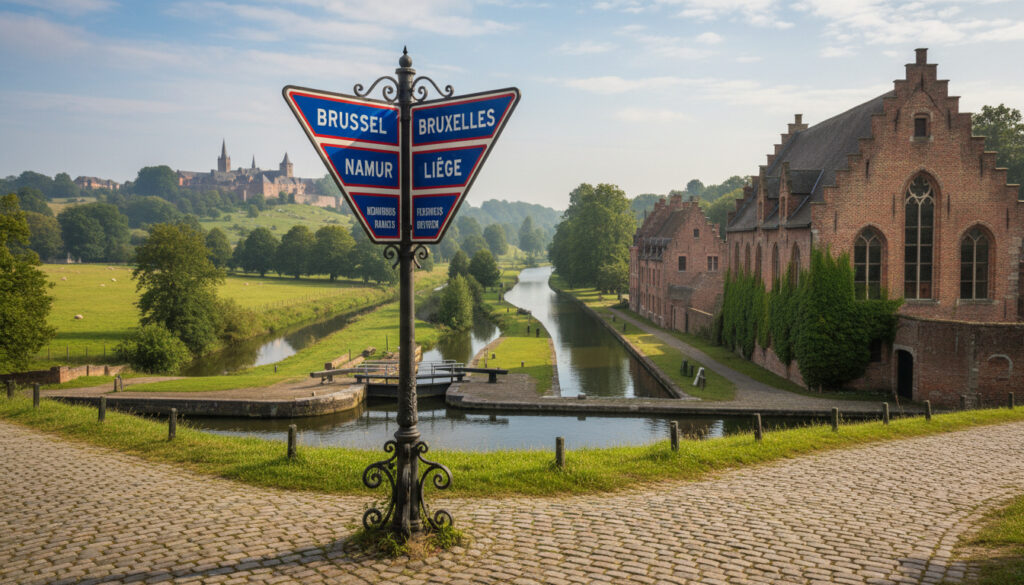
Despite French dominance, all public services, street signage, and official documentation appear in both languages throughout the capital. Travel resources confirm that visitors encounter bilingual infrastructure, though daily conversations overwhelmingly favor French.
Do People Speak English in Belgium?
Most Belgians speak or at least understand English, particularly in urban centers and among younger demographics. While English holds no official status at the federal level, it functions as the primary language of business in many international corporations and serves as the default communication mode in tourism and hospitality sectors.
Regional observations indicate that English proficiency varies by location, with higher concentrations of fluent speakers in Brussels and major Flemish cities compared to some rural Wallonian areas. Higher education institutions increasingly utilize English as an instructional language, particularly at the university level.
Words unique to Belgian Dutch and Belgian French are termed belgicisms. These vocabulary distinctions, along with pronunciation differences and semantic variations, mean that Belgian Dutch and Belgian French differ slightly from their counterparts in the Netherlands and France, though they remain mutually intelligible.
Within the German-speaking Community, many residents demonstrate bilingual capabilities in both French and German due to geographic proximity to French-speaking Wallonia and French language requirements in local educational curricula. This creates a distinct zone of individual bilingualism within the broader trilingual state structure.
Why Does Belgium Have Multiple Official Languages?
Belgium’s linguistic complexity stems from historical territorial arrangements and gradual constitutional evolution. The current system emerged through decades of political negotiation rather than a single foundational moment.
- : Following independence from the Netherlands, French establishes dominance as the sole language of government, aristocracy, and the legal system.
- : Parliament fixes the permanent language border dividing Dutch-speaking and French-speaking territories, establishing the foundation for regional autonomy.
- : The Dutch version of the Constitution achieves equal status to the original French version, ending French linguistic supremacy in legal documentation.
- : Belgium initiates federalization along linguistic lines, transferring significant authority to the three linguistic Communities.
- : The German version of the Constitution receives official recognition.
- : Belgium formally becomes a federal state organized around three linguistic Communities, completing the constitutional recognition of language-based governance.
Federal government documentation confirms that prior to these reforms, French generally functioned as the only language used by public authorities, creating systemic disadvantages for Dutch-speaking populations that the modern federal structure was designed to remedy.
What Is Definitive About Belgium’s Language Structure?
| Established Information | Variable or Context-Dependent Information |
|---|---|
| Three official languages: Dutch, French, and German | Exact percentage of English speakers varies by survey methodology |
| Four constitutional linguistic areas defined in Article 4 | Proportion of Brussels residents speaking Dutch as primary language fluctuates by census year |
| Brussels is officially bilingual (French and Dutch) | Future evolution of language policies remains subject to political negotiation |
| Flanders is officially monolingual Dutch | Individual proficiency in unofficial languages varies significantly by education level and age |
| Wallonia is officially monolingual French (except German-speaking municipalities) | Specific dialect usage within Flemish regions changes by locality |
How Did Historical Developments Create the Current Language Map?
From independence in 1830 through the mid-twentieth century, French maintained exclusive dominance in public administration, the military, and the judiciary. Dutch and German speakers faced significant barriers to accessing government services in their native languages. This asymmetry generated political tensions that eventually necessitated the federal restructuring of the Belgian state. You can find more information about DWP November 2025 payments at DWP November 2025 payments.
The gradual shift toward linguistic equality accelerated after World War II, culminating in the establishment of the four linguistic areas and the three Communities. Article 30 of the Constitution now guarantees that while citizens possess freedom of language in private matters, public authorities must operate according to specific linguistic regulations designed to protect minority language rights within each region.
Sources and Official Documentation
The use of languages spoken in Belgium is optional; only the law can rule on this matter, and only for acts of the public authorities and for legal matters.
— Article 30, Belgian Constitution
Factual assertions regarding language distribution derive from the Languages of Belgium entry and official Belgian federal statistics. Population figures and linguistic percentages reflect data from the CIA World Factbook and Ethnologue language databases. Constitutional articles and treaty references are verified against official government publications.
Summary: Navigating Belgium’s Linguistic Landscape
Visitors to Belgium encounter a nation where language determines geography: Dutch prevails in Flanders to the north, French dominates Wallonia to the south, German appears in the eastern cantons, and Brussels operates as a bilingual capital with French prevailing in daily discourse. While no single national language exists, English generally suffices for tourism and business, particularly in urban centers. The Languages of Belgium framework reflects not merely communication preferences but the fundamental constitutional architecture of the federal state.
Frequently Asked Questions
Is Flemish the same as Dutch?
Linguistically, the variety spoken in northern Belgium is Dutch, though colloquially called “Flemish.” It encompasses distinct dialects such as Brabantian and West Flemish and incorporates more Romance vocabulary than Dutch spoken in the Netherlands, though the two remain mutually intelligible.
What percentage of Belgians speak French?
Approximately 36% of Belgians speak French as their primary language, while roughly 45% speak it as a second language. About 40% of the population officially belongs to the French Community.
Where exactly is German spoken in Belgium?
The German-speaking Community of 79,500 residents occupies eastern Wallonia near the German border, specifically in territory ceded to Belgium following World War I through the Treaty of Versailles.
How many official languages does Belgium have?
Belgium recognizes three official languages: Dutch, French, and German. English, despite widespread usage, does not hold official status at the federal level.
Do they speak French or Dutch in Belgium?
Both languages are spoken, but in distinct regions. Dutch dominates Flanders in the north, French prevails in Wallonia in the south, and Brussels operates as a bilingual region with French serving as the predominant spoken language.
Can tourists rely on English in Belgium?
Yes, most Belgians, particularly in cities and tourist destinations, speak or understand English. While not an official language, English functions reliably in hospitality, business, and transportation contexts.
What are belgicisms?
Belgicisms refer to words unique to Belgian Dutch and Belgian French, encompassing vocabulary, pronunciation, and semantic differences that distinguish these varieties from those spoken in the Netherlands and France.
More related posts
 What Are Sea Monkeys – Facts, History and Biology
 Kerala Restaurants Near Me – Top UK Spots Compared
 Can Dogs Eat Peanuts – Safety, Risks and Benefits
 Mr and Mrs Smith Hotels – Complete Guide to Booking and Perks
 Auto Electrician Near Me – Reliable Local Experts and Repairs
 Andrew Santino – Net Worth, Wife, Podcast and Career
 When Does Implantation Occur – Complete Timeline and Symptoms
 Hot Air Balloons Crash – 8 Dead in Brazil, Cause Unknown