How to Work Out BMI – Step-by-Step Guide, Calculator & Ranges
Knowing how to work out your BMI is a quick way to check if your weight is in a healthy range for your height. The calculation itself is straightforward, but understanding what the number means—and its limitations—is just as important.
Body Mass Index is a screening tool used by health professionals worldwide. It is calculated using a simple formula, and the result places you into a category that can help indicate potential health risks. While it does not measure body fat directly, it serves as a useful starting point for a broader health conversation.
This guide walks through the step-by-step calculation using both metric and imperial units, explains the standard weight categories, and outlines where BMI is accurate and where it falls short.
How Do I Calculate My BMI? (Step-by-Step Formula)
To calculate your BMI, you need your weight and height. The formula changes depending on whether you use metric kilograms and centimetres or imperial pounds and inches. The core principle remains the same: divide weight by the square of height.
Weight (kg) ÷ [Height (m)]²
70 kg ÷ (1.75 m × 1.75 m) = 22.9
[Weight (lbs) ÷ Height (in)²] × 703
18.5 – 24.9
- BMI is a simple screening tool, not a diagnostic. It does not measure body fat percentage or distribution. Cleveland Clinic / NHS
- The formula is identical for men and women, but healthy ranges are the same; however, muscle mass can skew results. NHS / CDC
- For children and teens, BMI is age- and sex-specific (percentile charts). NHS Child BMI page
- Recent debates question BMI’s accuracy for diverse ethnicities and older adults. Research references
| Metric | Value / Detail |
|---|---|
| BMI Formula (Metric) | kg ÷ m² |
| BMI Formula (Imperial) | (lbs ÷ in²) × 703 |
| Healthy BMI Range | 18.5 – 24.9 |
| Overweight | 25 – 29.9 |
| Obese | 30 and above |
| Underweight | Below 18.5 |
| NHS Calculator | NHS BMI calculator (adults and children) |
How to Work Out BMI Using kg and cm (Metric)
For metric calculations, measure your weight in kilograms and your height in metres. Square your height first, then divide your weight by that number. The NHS provides a worked example: if you weigh 70 kg and are 1.70 m tall, square the height: 1.70 × 1.70 = 2.89. Then divide weight by that result: 70 ÷ 2.89 = 24.22, which rounds to 24.2. Source
How to Calculate BMI in Pounds and Inches (Imperial)
If you prefer imperial units, use this formula: BMI = 703 × weight (lb) / height (in)². A person who weighs 180 lb and is 65 inches tall has a BMI of 703 × 180 ÷ 65² = 29.95, rounding to 29.9. Source This places them in the overweight category. The same formula from the Cleveland Clinic and Ochsner Health is used consistently across medical sites.
If your weight is in stones or pounds, use a conversion guide to get kilograms for the metric formula. For example, 2 Stone in KG – Exact Conversion to 12.70 kg and Table can help convert imperial weight for calculation.
What Is a Healthy BMI Range? (Chart & Interpretation)
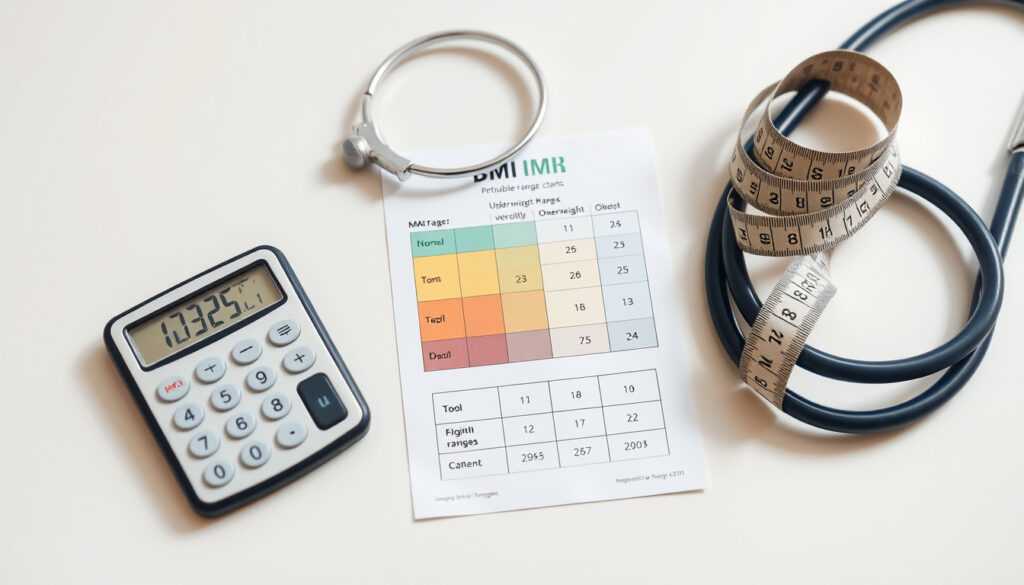
Once you have calculated your BMI, interpreting the number means checking it against standardised categories. These categories are used by the NHS, NHLBI, and the Heart Foundation to classify weight ranges in adults. Source
Common adult BMI categories are:
- Underweight: below 18.5
- Healthy weight: 18.5 to 24.9
- Overweight: 25.0 to 29.9
- Obesity: 30.0 and above
This chart applies to most adults. However, the CDC and NHS note that children and teens use a different BMI approach that accounts for age and sex. Source
How to Use the NHS BMI Calculator (UK Guidance)
The official NHS BMI calculator is the most authoritative tool for UK adults. It is hosted on the NHS website and uses the same formula described above. The calculator provides an instant result and places it within the standard healthy weight range. Source
The tool is designed for adults (typically 20+ in the CDC tool and adults generally in NHS guidance). It does not require age input for adults. For children, the NHS provides a separate child BMI calculator that uses percentile charts.
Beyond the NHS, tools such as the Heart Foundation BMI calculator and the CDC BMI calculator offer similar functionality with slight variations in presentation and additional risk information.
Is BMI Accurate? Limitations and Adjustments
BMI is a screening tool, not a direct measure of body fat or overall health. The Cleveland Clinic, Diabetes Canada, and CDC all note it can miss differences in body composition. Source
BMI does not distinguish between muscle and fat. A muscular person may have a high BMI but low body fat. It also does not reflect fat distribution, such as visceral fat around the abdomen, which is a stronger risk factor for heart disease.
Does BMI Work for Athletes?
For athletes with high muscle mass, the standard BMI formula often overestimates body fat. The Cleveland Clinic advises that athletes should not rely solely on BMI for health assessment.
Is BMI Accurate for Women?
The formula is the same for men and women, but hormonal changes during pregnancy and menopause can affect weight distribution and body composition. The NHS does not provide separate BMI thresholds for women.
How Does Age Affect BMI Interpretation?
For adults over 60, some experts suggest that a slightly higher BMI (up to 27) may be associated with better survival outcomes, although the standard range of 18.5–24.9 remains the official guideline.
How to Calculate BMI for Children and Teens
A child’s BMI must be interpreted differently from an adult’s. The calculation uses the same formula, but the result is plotted on a percentile chart that accounts for the child’s age and sex. The NHS child BMI calculator and the CDC both provide this percentile-based approach.
The CDC notes that children and teens use a different BMI approach than adults, which is essential for tracking growth patterns. Source
History of BMI
- 1832 – Adolphe Quetelet develops the Quetelet Index (later BMI) as part of social physics.
- 1972 – Ancel Keys coins the term “body mass index” and demonstrates its utility.
- 1990s – WHO adopts BMI as the standard for classifying obesity.
- 2020s – Growing calls to adjust BMI thresholds for different ethnic groups and incorporate waist circumference.
What BMI Can and Cannot Tell You
| Established Information | Information That Remains Unclear |
|---|---|
| BMI is a reliable screening tool for population-level health trends. | BMI does not distinguish between muscle and fat; a muscular person may have a high BMI but low body fat. |
| A high BMI (≥30) correlates with increased risk of chronic diseases such as type 2 diabetes and heart disease. | It does not reflect fat distribution (e.g., visceral vs. subcutaneous fat). |
| The calculation formula is standardised and reproducible. | For the elderly, BMI may underestimate body fat due to muscle loss. |
| Ethnicity-specific cut-offs are debated and not yet universally adopted (e.g., lower thresholds for Asian populations). |
Context for Using BMI Today
While BMI remains the most widely used weight-classification tool, health professionals recommend combining it with other measurements such as waist circumference, body fat percentage, and individual risk factors. For personal health, the NHS calculator provides a quick starting point, but a full health assessment should include blood pressure, cholesterol, and lifestyle evaluation. BMI is not a final verdict on health.
Sources and Expert Views
BMI is a useful population-level health measure, but it should be interpreted with caution on an individual level.
World Health Organization (WHO)
The BMI calculator gives you a quick idea of whether you’re a healthy weight for your height, but it’s not a complete health assessment.
NHS website
It’s important to remember that BMI is not a diagnostic tool. It’s a screening tool that can provide a starting point for a conversation with your doctor.
Cleveland Clinic
The WHO BMI Classification provides the global standard definitions and thresholds.
The Cleveland Clinic also offers a detailed medical overview with limitations and risks, available at Cleveland Clinic – Body Mass Index (BMI).
The Heart Foundation of Australia provides an Australian perspective with heart health context via their BMI Calculator.
Next Steps After Calculating Your BMI
If your BMI is outside the healthy range, consult your GP or a dietitian. Consider measuring your waist circumference for additional risk assessment. Incorporate a balanced diet and regular physical activity to manage weight. For parents, use the NHS child BMI calculator to track growth percentiles. Staying active is essential, and you can find guidance on daily step targets in How Many Steps Should I Walk a Day – Science-Backed Goals by Age.
Common Questions About BMI Calculation (FAQ)
How to work out BMI for females?
The formula is the same for females as for males: weight (kg) ÷ height (m)². There is no separate formula for women, but pregnancy and hormonal changes can affect interpretation. Always use the same calculator for consistency.
How to calculate BMI with age?
For adults (18+), the same BMI ranges apply regardless of age, but muscle loss in older adults can lead to overestimation of health. For children, age and sex are used to plot BMI on a percentile chart.
What is a normal BMI for a 60-year-old?
The standard healthy BMI range (18.5–24.9) applies to all adults, including those over 60. However, some experts suggest a slightly higher range (up to 27) for older adults to account for muscle loss and better survival outcomes.
What is the difference between adult and child BMI?
For adults, BMI is calculated using weight and height only. For children, the same calculation is plotted on a percentile chart that accounts for age and sex, which is essential for accurate interpretation.
Can I use the same formula in kilograms and pounds?
No. The metric formula uses kg and m. The imperial formula uses lb and in, with a multiplier of 703. Using the wrong formula will give an incorrect result.
Is BMI accurate if I have a lot of muscle?
No. BMI does not distinguish between muscle and fat. A muscular person may be classified as overweight or obese despite having low body fat. Alternative measurements like body fat percentage are recommended.
Does the NHS recommend BMI for everyone?
The NHS BMI calculator is for adults and children. It is recommended as a starting point for health assessment, but the NHS advises that it should be used alongside other health checks.
What is the BMI formula for the imperial system?
BMI = 703 × weight (lb) / height (in)². For example, 703 × 180 ÷ 65² = 29.9.
How often should I recalculate my BMI?
Recalculate periodically, such as every three to six months, especially if you are actively changing your diet or exercise routine. Rapid changes may warrant more frequent checks.
Can I use a BMI calculator if I am pregnant?
Standard BMI calculators are not recommended during pregnancy because weight gain is expected and not indicative of body composition changes. Consult a healthcare provider for weight monitoring.
More related posts
 Kebab Shop Near Me – Open Now, Delivery, and Top Rated
 Lee Jae-wook – Age Height Dramas Career Profile
 Ginevra Weasley – Complete Character Biography and Verified Facts
 Eminem The Real Slim Shady Lyrics – Full Song Meaning & Clean Version
 Man U vs Newcastle – Newcastle’s 2-0 Victory at Old Trafford
 Kerala Restaurants Near Me – Top UK Spots Compared
 How to Declutter Your Home – Complete Step-by-Step Guide
 Can You Take Aerosols on a Plane – UK Rules Guide