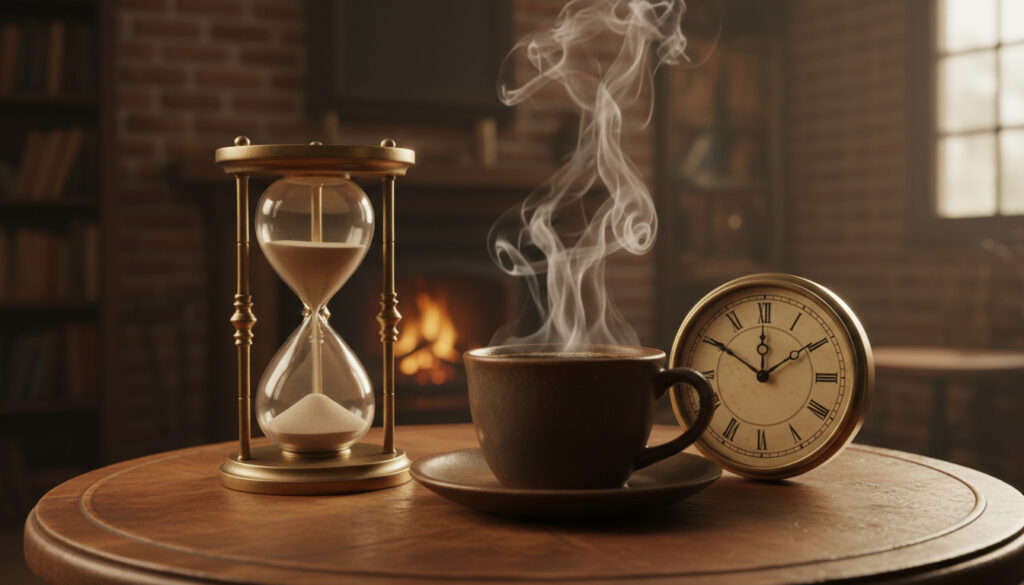
Before the Coffee Gets Cold – Complete Time Travel Guide
Before the Coffee Gets Cold is a 2015 Japanese novel by Toshikazu Kawaguchi that explores grief and second chances through a fantastical premise. Set entirely within a basement café named Funiculi Funicula, the narrative follows customers who discover they can travel through time by sitting in one specific seat, provided they follow strict rules that prevent them from altering the present.
The book has sold millions of copies worldwide since its English translation appeared in 2019. Its structure comprises four interconnected stories examining how different characters confront regrets, loss, and unresolved relationships when given exactly one hour in the past—or in one case, the future—before their coffee turns cold.
Critics and readers have praised the novel for its emotional depth and concise storytelling, with particular attention to how constrained time travel serves to illuminate human connection rather than fix past mistakes.
What is Before the Coffee Gets Cold About?
Toshikazu Kawaguchi
2015 (Japan), 2019 (English)
Fantasy/Time Travel
Series (4+ books)
Key Insights
- Explores four interconnected stories of regret, grief, and closure
- Set entirely in a windowless basement café with three antique clocks showing different times
- Time travel limited to approximately one hour before coffee cools
- Past cannot be changed, only experienced from a new perspective
- Combines magical realism with emotional drama about Alzheimer’s, death, and unspoken words
- Translated from Japanese original title Sayonara, Go Go!
| Attribute | Detail |
|---|---|
| Original Title | Sayonara, Go Go! |
| English Publication | 2019 |
| English Publisher | Hanako Haru |
| Setting | Funiculi Funicula Café, Tokyo |
| Structure | Four interconnected novellas |
| Main Characters | Fumiko, Kohtake, Hirai, Kei |
| Time Travel Duration | Approx. one hour |
| Key Theme | Emotional closure without altering past |
| Adaptations | Stage play (Japan) |
| Series Status | Four books published |
The narrative unfolds within Funiculi Funicula, a fictional café located down a narrow Tokyo alley. Only one specific seat enables time travel, occupied perpetually by a ghost—a woman who let her coffee go cold while waiting to meet her late husband. When living customers sit in this seat during the ghost’s brief absences and pour the special coffee, the steam transports their consciousness to different moments in time.
What Are the Rules of Time Travel in Before the Coffee Gets Cold?
The novel establishes five strict conditions that govern temporal displacement. These constraints prevent paradoxes while heightening the emotional stakes for each traveler. According to plot summaries, violating these rules carries severe consequences.
The Five Conditions
First, travelers must sit in the specific ghost-occupied seat, which is only available during the ghost’s occasional toilet breaks. Second, they cannot leave the seat or the café premises during their journey. Third, they can only meet people who have previously visited the café themselves. Fourth, and most significantly, they cannot alter the present no matter what actions they take in the past. Fifth, they must drink the entire cup of coffee before it gets cold.
Why the Past Cannot Change
The rules ensure that travelers return to an unchanged present, regardless of their interventions. This mechanic forces characters to seek emotional resolution rather than historical alteration. Whether confronting a departing lover or retrieving words from a spouse before Alzheimer’s took his memory, travelers must accept that their past remains fixed, while their understanding of it shifts.
Anyone who fails to drink the coffee before it cools becomes trapped as the new ghost who occupies the time-traveling seat, waiting eternally for the next customer to arrive.
Who Wrote Before the Coffee Gets Cold and What Are the Sequels?
Toshikazu Kawaguchi authored the original 2015 Japanese text, which emerged from a theatrical background before becoming a literary phenomenon. The work belongs to a larger series exploring similar themes through different visitors to the same café.
The Expanding Series
The Before the Coffee Gets Cold series currently comprises four main volumes. Publisher information confirms the sequence: Before the Coffee Gets Cold (2015), All the Answers We Never Had (2017), Before Your Memory Fades (2018), and One Cup of Coffee Before We Say Goodbye? (2020). Each installment introduces new customers while maintaining the same setting and rules.
Stories continue to unfold within Funiculi Funicula as subsequent characters explore their own specific regrets, whether seeking closure with deceased relatives or attempting to bridge gaps with estranged family members. The narrative structure remains consistent: interconnected vignettes bound by the café’s strict temporal mechanics.
While each book functions independently, reading the series chronologically provides deeper context for recurring café staff and the evolution of minor characters who appear across multiple volumes.
Is Before the Coffee Gets Cold Based on a True Story or Real Cafe?
The novel is pure fiction without basis in real events, though it draws upon universal experiences of loss and universal themes like Alzheimer’s. The café itself exists only in imagination, inspired by urban legends of mysterious Tokyo establishments rather than documented locations.
The Legend of Funiculi Funicula
Funiculi Funicula occupies a fictional basement space without windows, lit by shaded lamps. The name references the Neapolitan song “Funiculì, Funiculà,” commemorating a funicular railway, which symbolizes the brief ascent and descent of the time travel experience. While the café supposedly served coffee for over a century within the narrative, no real-world counterpart has been confirmed.
Stage and Screen Adaptations
A Japanese stage adaptation exists, though specific production details remain sparse. Film rights have reportedly sold, yet no major cinematic release has materialized as of current reports. No anime or television series adaptations have been detailed in available sources.
The café’s title evokes the Neapolitan song celebrating a funicular railway, symbolizing how the time travel experience briefly lifts visitors upward before returning them inevitably to ground level.
How Did Before the Coffee Gets Cold Develop Over Time?
- 2015: Original Japanese publication as Sayonara, Go Go!
- 2017: Second book released (All the Answers We Never Had)
- 2018: Third book published (Before Your Memory Fades)
- 2019: English translation of first book reaches international markets
- 2020: Fourth book released (One Cup of Coffee Before We Say Goodbye?)
What is Fact and What Remains Uncertain?
| Established Information | Information That Remains Unclear |
|---|---|
| Fiction confirmed by author; no real events basis | Specific real-world café that may have inspired the setting |
| Four books published in series | Status of potential film adaptation after rights sold |
| Japanese stage adaptation exists | Whether additional sequels beyond four are planned |
| Rules of time travel clearly defined in text | Scientific explanation for the supernatural mechanism |
| Ghost’s identity revealed as woman who lost husband | Exact historical period when café first opened |
What Cultural Themes Does the Novel Explore?
The narrative operates within distinctly Japanese sensibilities regarding impermanence and acceptance. Rather than treating time travel as a mechanism for correcting mistakes, the story embraces the concept of mono no aware—the bittersweet awareness of transient things. Characters learn that while they cannot rewrite history, they can reinterpret it, finding solace in understanding rather than alteration.
Thematic analyses highlight how the constrained rules force characters to confront their limitations. The café serves as a liminal space where desperation meets acceptance, where patrons must reconcile their desire to change the unchangeable with the necessity of moving forward.
For readers interested in how cultural works explore complex family histories and belonging across generations, the narrative offers insights that complement discussions of British Born Children of Migrants – Citizenship Rules Explained, particularly regarding identity and home.
What Do Critics Say About the Emotional Impact?
Reviews consistently praise the novel’s ability to deliver emotional impact within concise vignettes. The Goodreads consensus averages approximately 3.8/5, with readers describing the work as “heartwarming yet devastating” in its treatment of grief.
“Beautiful, moving exploration of time’s limits.”
The constrained travel rules reveal character growth through acceptance rather than action, creating poignancy that resonates beyond the supernatural premise.
— Literary Quicksand
Detailed summaries note that the interwoven narratives create a tapestry where each character’s journey illuminates the others, with café staff like barista Kazu serving as crucial connectors between the temporal travelers.
Where Should Readers Begin With the Series?
New readers should start with the 2019 English translation of Before the Coffee Gets Cold, which establishes the rules and setting through Fumiko, Kohtake, Hirai, and Kei’s interconnected stories. Those seeking to understand financial planning for book purchases might consult What Is a Current Account – Definition, Features and Savings Differences before acquiring the complete series. Each volume stands alone, though reading in publication order provides richer context for recurring characters.
Frequently Asked Questions
Is there a movie adaptation?
Film rights have sold, but no major movie has been confirmed or released as of current reports. A Japanese stage adaptation exists.
Can you read the book in English?
Yes. The English translation by Hanako Haru was published in 2019, followed by translations of the three sequels.
Do I need to read the books in order?
No. Each volume contains standalone stories, though reading chronologically reveals connections between recurring café staff.
Is the café Funiculi Funicula real?
No. The café is fictional, inspired by urban legends of narrow Tokyo alleys, with no confirmed real-world location.
Why can’t travelers change the past?
The rules state the present remains fixed regardless of past actions, forcing characters to seek emotional understanding rather than historical alteration.
How long does the time travel last?
Approximately one hour, or however long the coffee remains hot. Travelers must return before the coffee cools or become trapped.
Is this based on a true story?
No. It is pure fiction by Toshikazu Kawaguchi, though it addresses real conditions like Alzheimer’s and universal experiences of grief.
More related posts
 English to Bangla Translate – Best Apps, Tools and Tips
 Louise Brealey – From Sherlock Molly to Harry Potter Madame Hooch
 Furniture Stores Near Me – UK Chains, Deals and Locations
 Ronald Kray – Death, Partners and the Kray Twins Story
 Leeds United vs Aston Villa – Preview, Predictions and Lineups
 Eric Maxim Choupo-Moting – MLS Stats, FC Ratings and Career
 Eminem The Real Slim Shady Lyrics – Full Song Meaning & Clean Version
 Alex Oxlade-Chamberlain – The Comeback Story You Need to Know