Goldilocks and the Three Bears – Story Summary, Moral and Origins
Goldilocks and the Three Bears stands as one of the most recognizable fairy tales in English literature. This 19th-century British narrative follows a curious young girl who discovers a forest cottage inhabited by three bears, leading to a sequence of trespasses that end in sudden flight. The story has transcended its origins to become a cultural touchstone for lessons about boundaries and respect.
The tale operates through a deceptively simple structure. A child enters a domestic space uninvited, samples the inhabitants’ food, tests their furniture, and falls asleep in their beds—only to face the consequences when the rightful owners return. Yet beneath this straightforward plot lies a complex evolution of character and morality that reflects changing Victorian attitudes toward childhood, property, and social class.
Multiple versions of the story exist, each with distinct protagonists and endings. Understanding these variations reveals how folklore adapts to cultural expectations while maintaining core narrative functions.
What Is the Story of Goldilocks and the Three Bears?
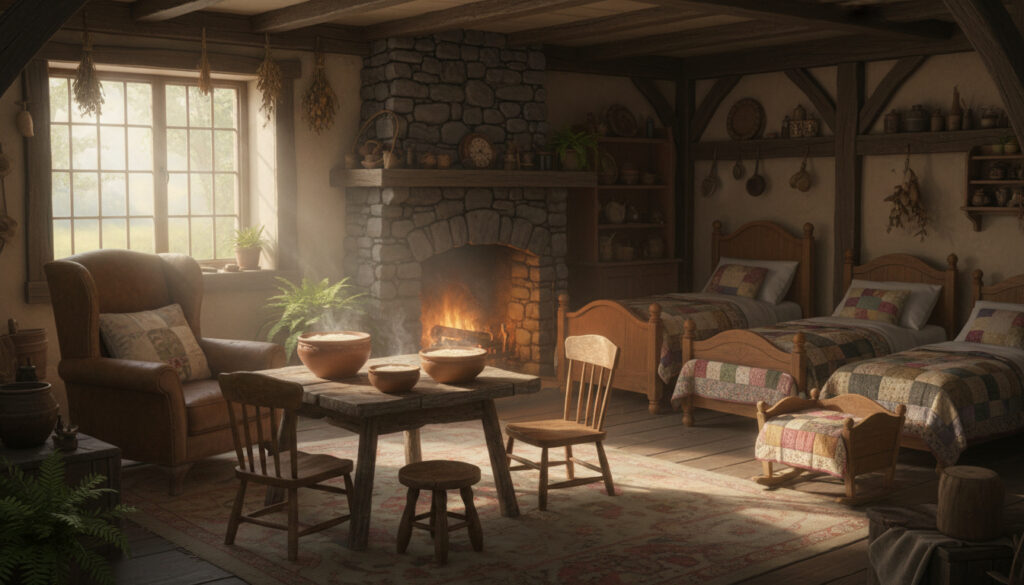
The narrative centers on a young blonde girl named Goldilocks who stumbles upon a cottage in the woods while the bear family—Papa Bear, Mama Bear, and Baby Bear—are away. Their porridge sits cooling on the table, creating the opportunity for the central conflict.
Origin
19th-century British fairy tale with oral traditions predating written documentation
Main Characters
Goldilocks (protagonist), Papa Bear/Father Bear, Mama Bear/Mother Bear, Baby Bear
Key Moral
Respect for others’ property and personal boundaries
Literary Device
Extensive use of the rule of three (porridge, chairs, beds)
The narrative structure creates three parallel sequences. Goldilocks tastes three bowls of porridge, finding the first too hot, the second too cold, and the third just right—which she consumes entirely. She then tests three chairs, sitting comfortably only in the smallest before it breaks in some versions. Finally, she tries three beds, discovering the smallest to be most comfortable, where she falls asleep. When the bears return, they discover eaten porridge, a broken chair, and Goldilocks sleeping in the baby bear’s bed.
What Are the Names of the Three Bears?
The bears are traditionally identified as Papa Bear (or Father Bear), Mama Bear (or Mother Bear), and Baby Bear. Character descriptions vary by version, though early texts characterize them as “good-natured, trusting, harmless, clean, and hospitable” rather than threatening predators.
Where Does Goldilocks and the Three Bears Take Place?
The setting consists of a cottage or house located in a forest or woods, positioned away from other dwellings. This isolated location proves essential to the plot, as the bears must leave their home while their porridge cools, creating the opportunity for Goldilocks’s intrusion.
Key Insights
- The narrative relies heavily on the rule of three, creating rhythm and anticipation through repetition
- The protagonist’s name derives from her blonde hair, introduced in Robert Southey’s 19th-century adaptation
- Original versions featured an elderly woman described as “insolent, mean, swearing, ugly, dirty, and a vagabond”
- The story demonstrates clear cause-and-effect regarding trespassing and uninvited intrusion
- The bears function as sympathetic victims rather than antagonists in early written versions
- The structure creates parallel discovery sequences for both Goldilocks and the returning bears
| Fact | Details |
|---|---|
| First Documented Appearance | 19th century |
| Popularized By | Robert Southey (1837) |
| Original Protagonist | Unnamed old woman (vagabond) |
| Current Protagonist | Goldilocks (young blonde girl) |
| Bear Family Structure | Father, Mother, Baby |
| Setting Type | Isolated forest cottage |
| Core Literary Device | Rule of three |
| Original Resolution | Protagonist flees through window |
| Primary Moral Theme | Respecting property and boundaries |
| Genre Classification | British fairy tale/folklore |
What Is the Moral of Goldilocks and the Three Bears?
The tale imparts crucial lessons about respecting others’ property and personal boundaries. Educational analysis indicates the story teaches mindfulness regarding others’ spaces and illustrates consequences of uninvited intrusion. The narrative suggests that respectful behavior might have resulted in friendship rather than fear.
Additional interpretation frames the story as a metaphorical exploration of “fitting in” and finding one’s proper place. Goldilocks must test each option—porridge, chair, and bed—before discovering what suits her needs, illustrating the process of trial and error in finding compatibility.
Why Is It Called Goldilocks and the Three Bears?
The title references Robert Southey’s characterization of the protagonist as a young, naive girl with blonde hair—literally “goldilocks.” This replaced earlier versions featuring an unnamed old woman. The “Three Bears” emphasizes the family unit structure Southey introduced, transforming earlier bachelor bears into a nuclear family representing different generations and sizes.
Beyond its moral about trespassing, the story functions as a metaphor for finding one’s proper fit. Goldilocks must sample each option before discovering what suits her specific needs, illustrating that compatibility requires testing and comparison.
Who Wrote Goldilocks and the Three Bears?
While no single author created the tale from whole cloth, Robert Southey bears responsibility for the version known today. The poet laureate transformed an older oral tradition featuring an unpleasant old woman into a narrative about a child named Goldilocks. Southey’s version established the bears as “good-natured, trusting, harmless, clean, and hospitable” rather than threatening predators, fundamentally shifting the story’s tone.
Is Goldilocks and the Three Bears a Grimm Fairy Tale?
Despite common misconceptions, this story does not originate from the Brothers Grimm collection. The tale emerged from British folklore rather than German traditions. Its 19th-century documentation places it later than many Grimm tales, and its structural elements reflect English storytelling conventions rather than the darker Germanic folklore traditions.
How Old Is the Goldilocks Story?
The narrative first appeared in documented form during the 19th century, though oral versions likely circulated earlier. Scholarly consensus places the earliest written versions in the 1800s, with Southey’s adaptation solidifying the modern form shortly thereafter. The tale exists in three distinct versions: the original with the old woman, Southey’s Goldilocks adaptation, and the modern family-centered story widely told today.
What Is the Original Ending of Goldilocks and the Three Bears?
In the original and Southey versions, confrontation leads to flight rather than reconciliation. Source texts confirm that when Goldilocks awakens to find the bears observing her, she becomes frightened and leaps out the window. Early summaries describe her running into the forest never to return, with the bears never learning her identity.
What Happens to Goldilocks at the End?
The protagonist escapes through the window and flees into the woods. Unlike some sanitized modern adaptations, the traditional ending offers no reconciliation or return visit. The abrupt departure serves as the immediate consequence of her trespassing, ending the interaction permanently.
Differences Between Goldilocks Versions
Three distinct versions exist. The earliest featured an elderly vagrant described with explicitly negative characteristics including swearing and poor hygiene. Southey replaced her with the innocent Goldilocks and transformed bachelor bears into a family unit. The modern version combines these elements into the family-centered narrative told today, often softening the moral consequences.
The original protagonist was not a curious child but an elderly vagrant representing Victorian anxieties about property and social class. This character was described as “insolent, mean, swearing, ugly, dirty, and a vagabond.”
Unlike many fairy tales that end with punishment or transformation, Goldilocks simply escapes. The bears’ failure to catch her or learn her identity creates an unresolved tension rare in traditional folklore.
How Did the Goldilocks Tale Evolve Through History?
- Pre-1840s: Oral circulation of tale featuring old woman and three bachelor bears (British folklore)
- 1837: Robert Southey publishes version with Goldilocks character and family unit bears
- 1840s–1850s: Story gains popularity in Victorian children’s literature
- 20th Century: Standardization into modern family-centered version with softened moral tones
- Present: Educational tool for teaching respect and comparison concepts
Sources: Wikipedia, Figments and Fables
Which Facts About Goldilocks Are Historically Verified?
| Established Information | Information That Remains Unclear |
|---|---|
| 19th-century British origins | Precise oral tradition timeline before written documentation |
| Robert Southey’s 1837 adaptation | Identity of original oral storytellers |
| Three distinct version categories exist | Exact date of first written transmission |
| Original protagonist was an old woman | Whether Southey invented the name Goldilocks or adapted existing folklore |
| Bears characterized as hospitable in early texts | Full extent of textual variations lost to time |
What Cultural Context Produced the Goldilocks Story?
The tale emerged during the Victorian era, reflecting specific social anxieties about property, class, and domestic security. The transformation of the protagonist from a “dirty vagabond” to an innocent blonde girl mirrors changing attitudes toward poverty and childhood innocence during the 19th century. This shift allowed the story to function as moral instruction for middle-class children rather than a warning about the lower classes.
The story’s forest setting—an isolated cottage away from other dwellings—establishes a threshold between civilization and wilderness common in British folklore. This liminal space allows for the testing of social rules without permanent consequence, as Goldilocks retreats back to society while the bears remain in their domestic sphere. For readers exploring how settings shape narrative meaning, Before the Coffee Gets Cold – Complete Time Travel Guide examines similar liminal spaces in contemporary fiction, though focused on temporal rather than geographic thresholds.
What Do Source Materials Reveal About Goldilocks?
The original version features an impudent old woman described as “insolent, mean, swearing, ugly, dirty, and a vagabond” who intrudes upon the home of three bachelor bears.
— Historical analysis of early Goldilocks variants
Southey’s bears were characterized as “good-natured, trusting, harmless, clean, and hospitable,” establishing them as victims rather than threats.
— Robert Southey’s original text
Why Does Goldilocks Endure in Modern Culture?
Goldilocks and the Three Bears persists because its simple structure contains complex truths about respect, curiosity, and consequences. The tale offers children clear moral guidance while providing adults with insight into narrative efficiency and cultural evolution. For those interested in how stories transcend their original contexts, Before the Coffee Gets Cold – Book Summary Series Guide explores similar themes of narrative longevity across different genres and time periods.
Frequently Asked Questions
Is Goldilocks and the Three Bears appropriate for all ages?
Yes, the tale is widely considered suitable for children, teaching lessons about respect and boundaries without graphic violence or permanent harm to characters.
What are the specific names of the three bears?
The bears are traditionally identified as Papa Bear (or Father Bear), Mama Bear (or Mother Bear), and Baby Bear.
Why is the number three significant in the story?
The “rule of three” creates narrative rhythm and satisfaction, appearing in the three bears, bowls of porridge, chairs, and beds.
Does Goldilocks face punishment in the original story?
No, she escapes through the window and flees into the forest without facing direct punishment from the bears.
Is there a real cottage associated with the story?
The cottage is fictional, though it draws on archetypal British forest dwellings common in Victorian imagination.
How does the moral differ between versions?
Early versions emphasized class and hygiene concerns, while modern versions focus on respecting property and personal space.
Why did the protagonist change from an old woman to a young girl?
Robert Southey’s 1837 adaptation replaced the old woman with Goldilocks to create a more sympathetic character for Victorian children.
More related posts
 Pound Rate in Pakistan Today – Live GBP to PKR Compared
 Clothing Stores – Best Online, High Street and Cheap Finds in UK 2025
 What Is a Current Account – Definition, Features and Savings Differences
 Inheritance Tax When Second Parent Dies – Up to £1m Tax-Free
 Richard Osman Books in Order – Complete Guide to Series and Releases
 Mary Berry Carrot Cake Recipe – Full Guide with Tips and Variations
 Matt Groening – Biography, Net Worth, Wife and Children
 Auto Electrician Near Me – Reliable Local Experts and Repairs